
Compare Madison County Value Types
Value figures in Madison County records serve different purposes. The PVA assesses every taxable parcel each year at fair cash value under KRS 132.690. A recorded sale price covers one transaction. A private appraisal answers only to its own methods and a stated date.
| Value type | What it means | Where it is recorded |
|---|---|---|
| Assessed value | The annual tax-roll figure | Madison County PVA record |
| Fair cash or market concept | The statutory valuation basis, not a sale promise | PVA assessment process |
| Last sale price | Consideration from a past transfer when shown | Deed and paid PVA subscription features |
| Land and improvements | Components requested on a detailed parcel card | PVA card when exposed |
Sales come with quirks. A deed can reflect unusual terms, personal property, family ties, or only part of an interest. An assessment sticks to the roll's date. Match like value types from the same period before comparing one parcel with another.
Choose Madison County Value Access
The Madison County PVA describes its basic ownership and assessed-value search as free. Paid access goes further. Subscriptions add transfer history when available. They also add sales listings searchable by price or date, photos, improvement features, property class, and tax information. Filters can narrow sales by acreage, year built, sale type, neighborhood, and qualified status. Other traits work as screens too.
These tools support comparison work. Still, "qualified" is only a data classification. It does not guarantee that one sale proves current market value. So weigh several before trusting a figure.
Note: Keep the assessment year and access level with any Madison County property value you cite.
Open Madison County's Value Search
Searchers can enter the official portal by Address, PIN, Parcel, Account, Subdivision, Name, or Company. The address route fits the value question. Keep the parcel ID handy so the result never mismatches. Open the PVA assessment search and start there.
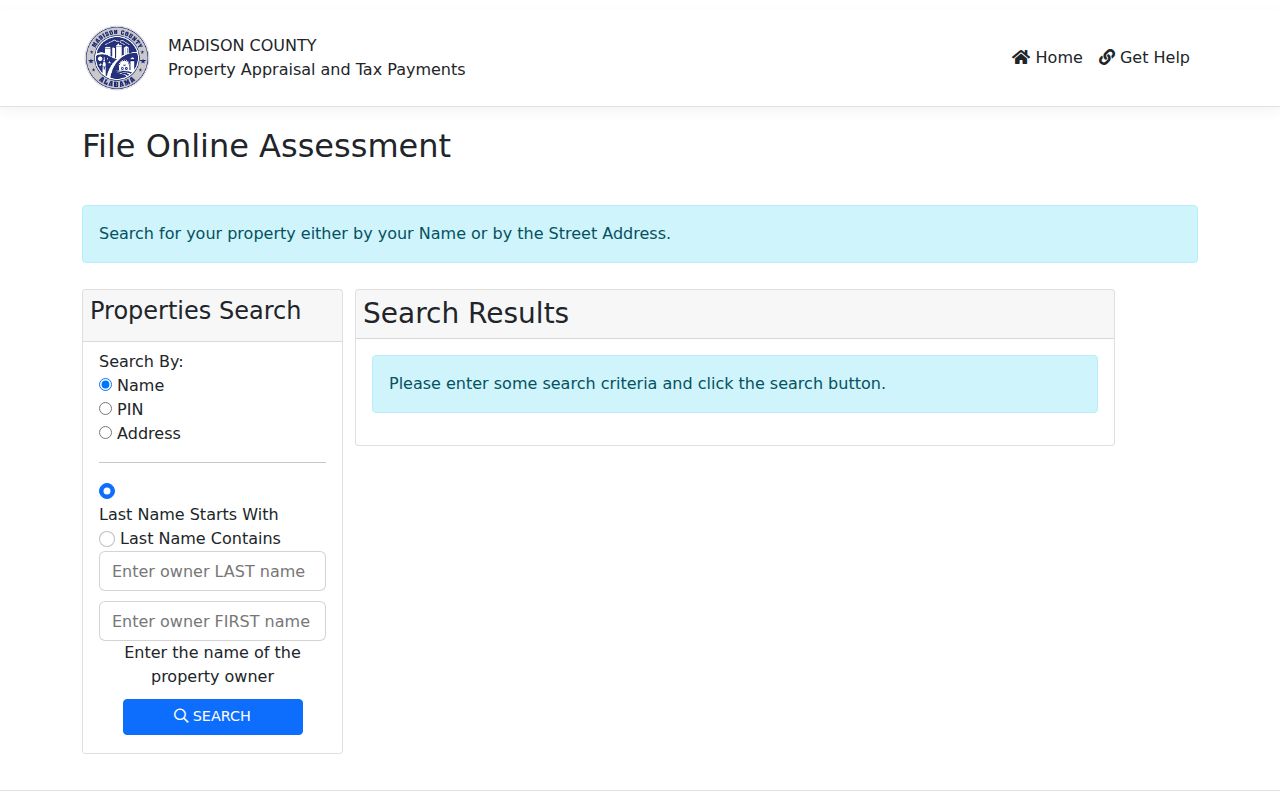
The image charts the search route itself. Exact value labels come from the live parcel card once a result renders.
Estimate Madison County Record Value
Identify the value type and year from the roll first. Never swap a tax-bill amount, a GIS image, or an old sale price for an assessed value.
- Search the address and confirm the PIN, situs, and tax year.
- Record each displayed value under its exact field label.
- Check transfer history or the recorded deed for the date and consideration of the last sale.
- Compare similar properties only after aligning dates, use, acreage, and improvement traits.
- Assessed value
- The figure carried on the tax roll for the stated year.
- Market value
- An estimate of likely exchange under defined market conditions.
- Sale price
- The consideration from one transfer, not a timeless value.
- Reassessment
- A new review or update of the property's roll value.
Rates, exemptions, and the challenge process belong to the dedicated property tax record. Those issues change what is owed without altering the meaning of the underlying value field.
Understand Madison County's Review Cycle
The PVA real-property page sets the schedule. Every taxable parcel gets an annual assessment. Each one also receives a physical examination at least once every four years. Reviews can happen off-cycle too. City permits, electrical inspections, manufactured-home transfers, field measurements, and photos feed that field work. The roll is still annual, and new facts can shift a value in any year, so keep the record year with every comparison.
Explain Madison County Sale Gaps
A recent sale and a current assessed value can disagree. Neither record is wrong. The roll carries a January 1 context. A transfer after that date can leave old ownership details sitting on the tax bill. The transaction itself may be atypical. Paid sales tools bring filters for date, price, acreage, year built, sale type, and neighborhood. You can also filter by qualified status. Lean on several sound comparisons and document the selection rules. Do not trust one nearby transaction.
Keep Madison County GIS in Context
Parcel and aerial layers reveal tract shape, access, improvements, zoning context, and nearby development. That context explains why two records differ. GIS imagery is not an appraisal. County GIS stays live and continuously updated. Record the map date with anything pulled from it. A recorded plat or deed legal description can surface acreage, easements, or a parcel split that a basic value screen leaves unexplained, and those facts sharpen a comparison without creating a new value on their own.
Record Madison County Value Evidence
A solid value note lists the PIN, situs, roll year, exact field label, amount, and the date you pulled it. Sale context calls for more. Add the sale date, consideration, deed reference, and any qualified-sale label so an old transfer cannot pose as a current estimate.
Claim only labels visible on the record you select. Do not guess at field values. Photos, traits, and transfer history sit behind paid access when available, so verify those on the live card.
The PVA office at 135 W. Irvine Street, Suite 103, Richmond, can clarify an assessment at (859) 623-5410. It assesses property. It does not set rates or collect bills.
Compare Madison County Improvement Facts
The Madison County assessment process pulls from many sources. Building permits, electrical inspections, manufactured-home transfers, field measurements, and photographs all feed into it. That mix explains why a parcel's roll value shifts after work is done. It does not, however, produce a public sale price. A permit amount is not the market value of the finished improvement. Treat it only as a signal that the assessor reviewed the change.
A detailed PVA card may break out land, improvement, and total figures. Keep those labels straight. Land covers the site itself. Improvements cover taxable structures and additions the roll reflects. The total means something only for the assessment year stated on the record. The property records themselves may spell out the relationship. Otherwise, do not subtract or recombine the fields.
Compare traits before comparing dollar amounts in any Madison County property search. Acreage, year built, property class, neighborhood, sale type, and improvement characteristics help. They are among the PVA's paid search filters. Similar street addresses can still mean unlike parcels. A sound comparison of Madison County property records explains why the chosen sales qualify. It also flags any missing characteristic instead of papering over the gap.
Limit Madison County Value Claims
An assessed value is a tax-roll figure. Nothing more. The deed records and property records say nothing about a guaranteed asking price, a repair budget, an insurance amount, or a future sale result. For a defensible number tied to one parcel, a licensed appraisal applies property-specific analysis to a defined valuation need.
Value is not price. A Madison County assessed value supports taxation. It is not what the property must sell for and is not a private appraisal.
The PVA does not set tax rates or collect the bill. The Sheriff handles collection of current taxes, so keep valuation questions about the assessor's roll separate from payment, delinquency, and appeal matters shown on the tax bill.