
Fields in Madison Tax Records
Three offices split the job in Madison County. The PVA assesses each parcel; the Sheriff collects the current tax bill. Once the collection deadline passes, the Clerk takes over delinquent county bills. Splitting the roles keeps the offices distinct. That separation keeps an assessed value from being mistaken for an amount due on the tax roll.
| Field | What It Shows | Where |
|---|---|---|
| Assessed value | Annual fair-cash-value assessment | Madison County PVA |
| Owner and parcel key | Tax-roll name and PIN, parcel, or account | PVA |
| Exemption | Relief reflected on the assessment | PVA |
| Bill and payment | Rates, subtotals, amount, and status | Sheriff |
| Delinquency | Transferred bill and sale administration | County Clerk |
One bill can carry personal-property value, jurisdiction rates, and subtotals. Remember, a recorded sale price is a separate figure. The tax amount on a Madison County bill is not a market appraisal.
Madison PVA Sets the Value
Every taxable parcel in Madison County gets an annual assessment at fair cash value under KRS 132.690, according to the Madison County PVA. The office must physically examine each parcel at least once every four years. Field work can happen at other times too. Permits, inspections, transfers, photos, and measurements may all feed the appraisal.
The PVA never sets tax rates. It never collects the tax bill either. A free property search returns basic ownership and the assessed value. Paid access adds history, sales tools, photos, improvements, class, and tax detail where available.
January 1 Controls Madison Bills
January 1 fixes the assessment date in Madison County. A buyer who closes later may find the former owner of record still listed on the property tax record until the next year. The new name might sit in a care-of line. It might not appear at all.
That lag is pure timing, not evidence the deed failed. Compare the tax year with the deed recording date. Check current deed records before deciding who truly owns the parcel.
Note: A Madison tax-roll owner can lag a deed recorded after January 1.
Madison Tax Search Fields
The legacy tax collector form offers several ways in. Search by owner, street, property number, bill number, roll type, or year. A property-number example uses grouped digits. Don't assume it matches the PVA PIN format.
| Search Field | Best Starting Evidence | Check |
|---|---|---|
| Owner | Tax-roll name | Spelling and tax year |
| Street | Known situs | Suffix and number |
| Property number | Prior bill | System-specific label |
| Bill number | Current notice | Year and roll type |
The official Madison County tax search is shown below.
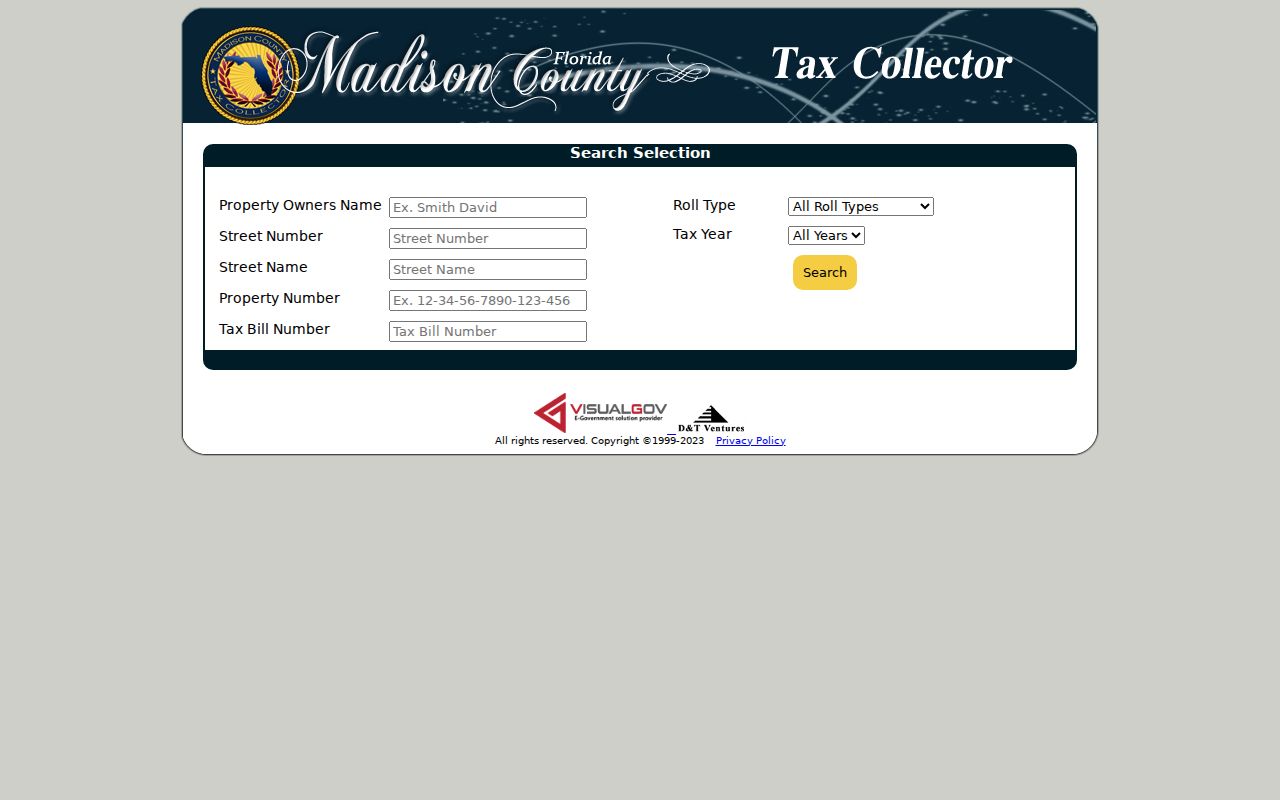
The official form helps you pick the right field without treating the online tax data as a final payment quote.
Look Up a Madison Tax Bill
Begin with the parcel number or a known address, then work from assessment toward collection. The Madison County Sheriff property-tax page handles current payments. It also notes that data on the web is unofficial.
- Find the PVA parcel and note the selected year, owner, and parcel keys.
- Search the Sheriff-linked bill route and read each jurisdiction subtotal.
- Compare any exemption with the PVA record.
- If unpaid after transfer, check the Clerk's delinquent-tax records and current notices.
- Assessed value
- The value placed on the tax roll.
- Levy or rate
- The charge applied by a taxing district.
- Homestead exemption
- Property-tax relief for a qualifying home.
- Tax lien
- A public claim tied to unpaid tax.
Madison Sheriff Payment Route
Current payments go to the Sheriff in person. You can also pay by mail at 135 W Irvine Street, Suite B01, Richmond. Weekday service hours apply, and the office takes cash, checks, money orders, and cards. Pay early and you get a 2 percent discount. A returned check costs $25. An escrow arrangement does not stop a bill from arriving. Owners with mortgage escrow should confirm the Sheriff actually received payment. The online display carries no official weight. Questions about assessment belong with the PVA. The PVA can explain values, but it neither collects nor corrects payments.
Madison Delinquent Tax Transfer
Once the Sheriff's deadline passes, unpaid county tax bills move to the County Clerk. The 2026 schedule marks April 16 as the delinquency date. Third-party purchasers must register by August 17. The tax sale itself is set for August 27 at 9:00 AM. Treat those as 2026 specifics rather than standing annual rules. One misconception trips up many researchers. The bill or certificate is what sells, never the property itself in a direct public conveyance. Any sale entry needs tracing through assignments, redemption, deeds, and court records. Only then does it prove who holds title.
Tax bill, not a deed. A Madison County tax-sale listing does not by itself show that title changed hands.
Madison Exemption Forms
The PVA posts exemption forms for agriculture, nonprofit property, homestead, religious use, and tangible property. Eligibility turns on the current form and the facts behind each claim. So rely on the PVA forms page rather than an old saved copy. An exemption only shifts taxable treatment. It never rewrites the deed's ownership history or converts assessed value into a market price. If an expected exemption is missing from the tax roll, contact the PVA. Act before the appeal window closes.
Contest a Madison Assessment
A property owner who disagrees with a Madison County assessment has a clear starting point: the PVA appeals process. The first step is an inspection plus a conference, held during the statutory May window. From there, an appeal moves to the local board using a County Clerk form. Further review follows the state path if needed.
Evidence strengthens any challenge. Comparable sales can support a different value. An appraisal can too. So can construction cost, or income and expense figures. The calendar matters, though. Check the current PVA notice for the filing period. Do not trust last year's schedule.
Current appeal window. Madison County requires the PVA conference before the board route, and the current May dates must be confirmed each year.
Read Madison Tax District Subtotals
A Madison County tax bill stacks several districts together. Fiscal court, schools, and the library each add lines. Emergency services, health, and extension add more. Sometimes a city or watershed district appears too. The city rate is just one slice. Read each district line on its own. Do not divide the bill by a single headline rate.
Jurisdiction matters too. County planning leaves out Richmond and Berea. Municipal status decides which city line shows up. A mailing address or ZIP code proves nothing about city limits. Check the parcel in GIS and against the official assessment record before drawing conclusions.
Year-to-year swings can come from a new value. A district change, an exemption, a correction, or a rate move can also shift the total. Keep both annual property tax records before blaming one cause. The Madison County property value guide sorts out assessed, market, and sale figures.
Verify Madison Tax Status Offline
Online property tax records offer a useful lead. Its own page calls the Sheriff's displayed information unofficial. A payoff or closing needs more. The same goes for a dispute or proof of payment, so call the Sheriff's office at (859) 623-1511 or use its published in-person and mail channels. Keep your receipt and the parcel or bill number.
Once a county bill goes delinquent, direct the question to the Clerk. Ask whether the record shows a certificate, an assignment, a payment plan, a redemption, a release, or a later deed. A tax-sale list is a snapshot. It captures one point in a longer process and should never name a current owner on its own.
Need a historical or custom tax dataset the normal portals cannot produce? Madison County's open-records form covers that. Describe a defined year, field set, parcel group, or report, since broad requests for every related record can be too vague under Kentucky guidance.
An appeal record should preserve both sides. The PVA names comparable sales, income and expense material, an appraisal, and construction cost as examples that may help. Photographs help. Permit facts and improvement characteristics can too. Together they explain why two parcels that look similar on a map do not carry the same assessment, and why the PVA conference comes first, since the local board route follows that review.
A physical review at least once every four years does not limit changes to that schedule. The PVA may inspect an area at another time. City permits, electrical inspectors, mobile-home transfers, park owners, measurements, and photographs can also affect the record. So a yearly shift is not automatically an error. Compare first. Weigh the effective tax year against the stated property characteristics before treating an annual change as a mistake.
Payment records need a clear cutoff. The Sheriff handles the current collection period and lists a mail and counter route. The Clerk takes delinquent county bills. Sometimes an online entry and a receipt conflict. Give the office the bill number, property number, owner name, tax year, payment date, and method so it can sort things out. A mortgage escrow arrangement does not remove the need to confirm that payment reached the correct account.
The 2026 delinquent schedule includes publication and payment-plan dates. It also lists purchaser registration and sale dates. Those milestones can shift in a later year, so preserve a dated copy of the current notice before relying on any deadline. Also distinguish a certificate assignment or sale from a deed, because redemption, later filings, and court action can determine what happened after the published event.
Kentucky property tax records can also point toward court or recording follow-up. A recorded tax lien, certificate assignment, release, or later deed belongs in the Clerk's index. Some disputes land in court. A contested collection, foreclosure-related filing, redemption dispute, or judgment may have a local court file. CourtNet offers the index lead. The Madison Circuit Clerk holds the official case record. Match the case number and final order to the parcel and the recorded instrument before treating the dispute as resolved.