
Madison Deed Types and Uses
The Madison County Clerk records deeds and other land instruments for the county. Knowing the document type matters. A deed, mortgage, lien, release, and plat each answer a different question about a property.
| Deed Type | What It Does | Common Use |
|---|---|---|
| Warranty deed | Conveys an interest with stated covenants | Ordinary sale or transfer |
| Quitclaim deed | Conveys whatever interest the grantor holds | Corrective or family transfer |
| Fiduciary deed | Conveys through an authorized representative | Estate or court process |
| Plat | Records lots, tracts, roads, and easements | Subdivision reference |
A deed conveys an interest in land. A mortgage or lien records a claim against it. Read later releases and related instruments too, because one filing alone rarely tells the whole story.
Madison's Name-Only Deed Index
The Madison County Clerk recording page states something clear. All records are searchable by a person's name only. That is a hard limit. An address or PIN can reveal the owner of record through the PVA. But neither is the Clerk's index key. Search current and former parties, spouses, and fiduciaries. Search exact entity variants when you walk the chain. Both recording branches serve as fallbacks when an online image is missing. Richmond sits at 321 N. Madison Avenue, and Berea is at 304 Chestnut Street. Richmond also warns about morning e-recording work. It can make wait-ons unavailable until roughly 9:30 to 10:00. The official recording page shows the Clerk's access route.
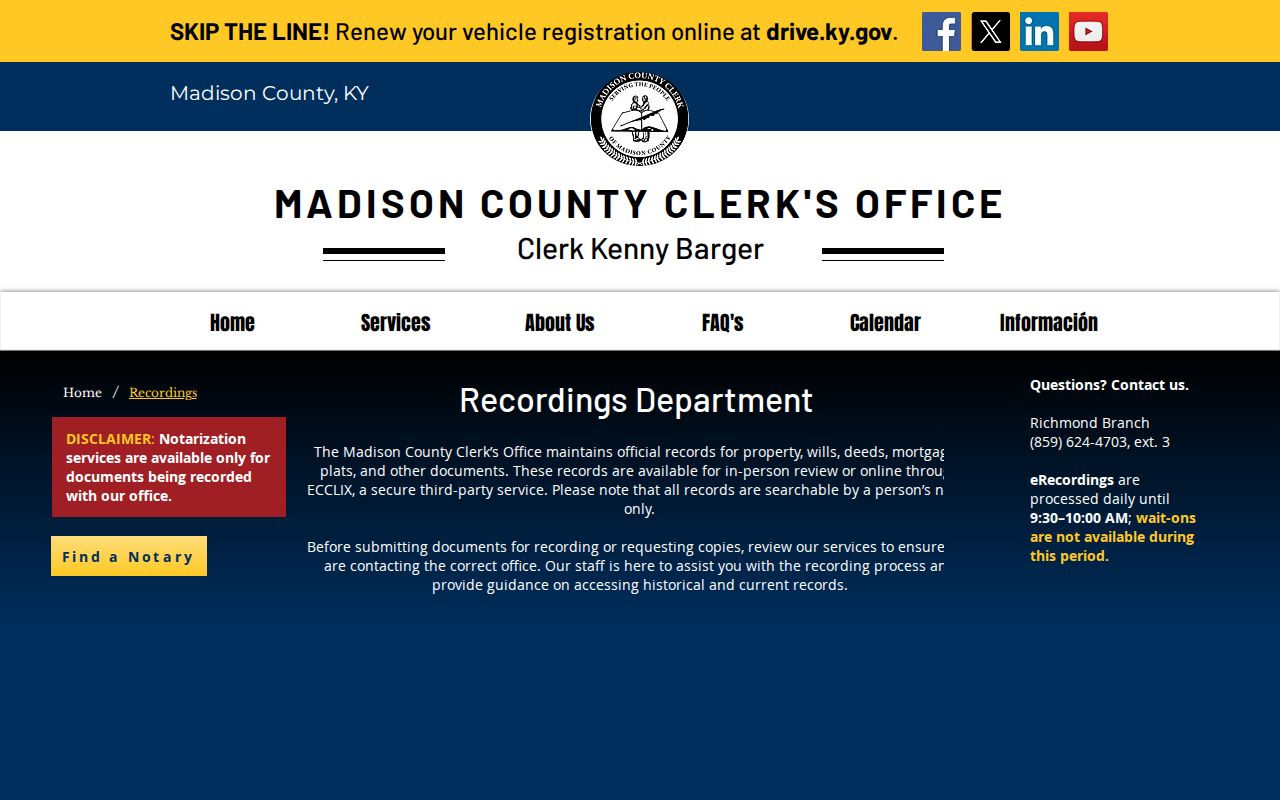
The capture documents the name-only rule and current office links.
Madison Deeds Through eCCLIX
eCCLIX Central Kentucky Land Records is the Clerk-linked online service for deed records. Its public page shows login, getting-started, subscription, and sign-up routes. The service publishes no reliable Madison field inventory or sample result, so confirm the live controls yourself before relying on them. Published pricing lists two paths. The first-county monthly setup is $200, followed by $75 per month, while the day path charges a $45 first-county setup plus $15 per 24 hours. Added counties and users carry added charges. Recheck the service before purchase. The portal entry screen appears below.
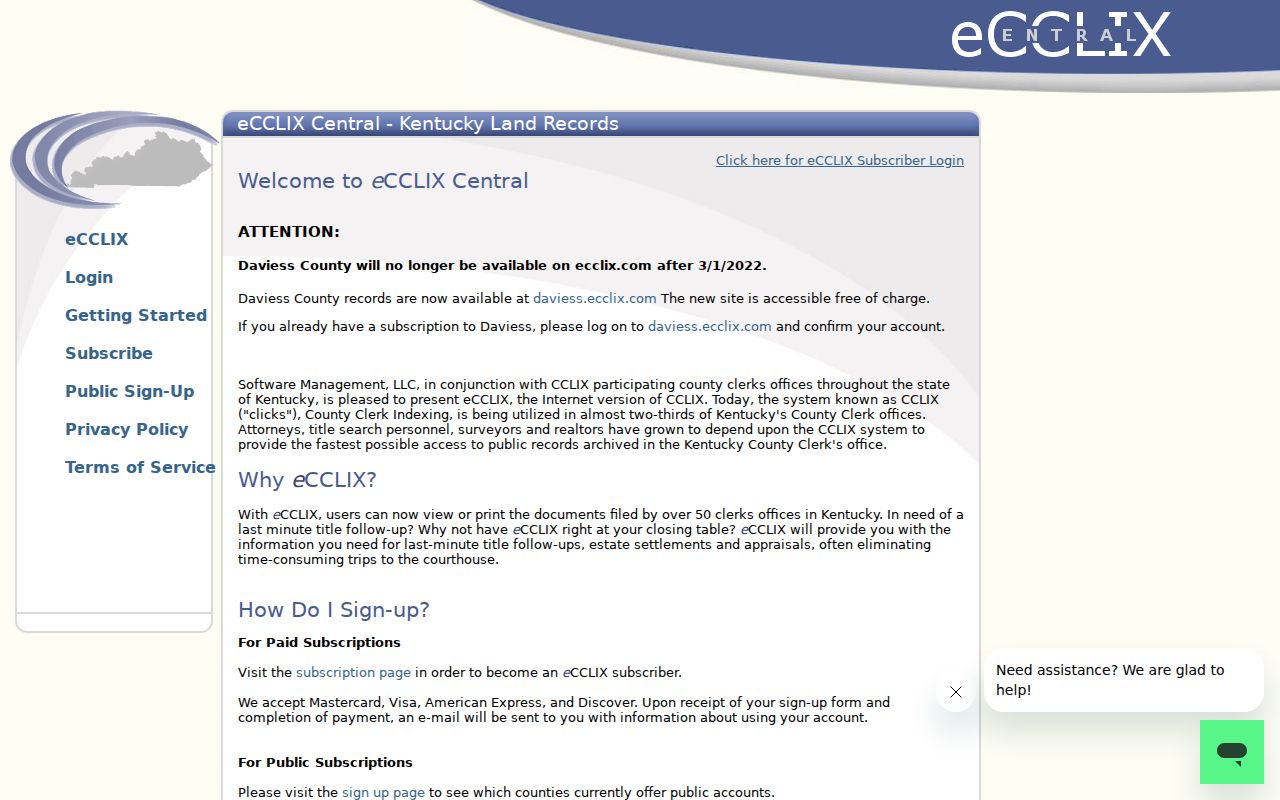
The image confirms the access path, not a sample deed result.
Madison Deeds Reach to 1786
The Clerk's genealogy inventory lists Madison County deeds from 1786 to the present. Plats run from 1800 forward. The county itself dates to 1785, when Kentucky was still part of Virginia. Early county business began near Milford. The seat moved to Richmond in 1798. Those facts help decode old place names. They also explain why the modern portal is not the whole archive. When an old image is absent online, ask for the deed book or plat book. Do not treat the interface cutoff as the record cutoff. Library, archives, and historical collections can supply name clues. But the Clerk's original instrument remains the land-record source.
Walk Madison's Grantor-Grantee Chain
A grantor transfers an interest; a grantee receives it. Chain of title is the linked sequence of conveyances affecting one parcel. Start from a known recent deed and work backward through the index.
- Find the current owner's acquisition deed by searching that owner as grantee.
- Copy the grantor, deed type, date, reference, and legal description.
- Search the grantor as an earlier grantee and confirm that the land description matches.
- Repeat, then move to deed books or Clerk assistance when the online path ends.
- Grantor
- The party transferring an interest.
- Grantee
- The party receiving an interest.
- Chain of title
- The ordered sequence of title events.
- Book/page
- A bound-record location.
- Instrument number
- An identifier assigned to a filing.
Madison Fees Need a Date
The Clerk's fee PDF is dated 2020. It lists a deed and a plat at $50 each, with a certified copy at $5 plus $0.50 per page after three pages. Added pages and references can raise the total. Those figures document a dated schedule, not a guaranteed current invoice. Consult the official fee schedule and call the Clerk before sending funds. State the deed type, page count, references, and whether you need certification.
Madison Plats Clarify Deeds
A deed may refer to a lot, block, subdivision, tract, easement, or prior instrument. A plat records surveyed divisions. It can carry bearings, distances, roads, restrictions, and certifications.
The Calley Property plan at Curtis Pike shows six tracts. Each tract comes with bearings, easements, restrictions, and survey notes. It demonstrates why GIS geometry is only a visual aid. Match deed records to the recorded plat. Then use a qualified surveyor for a disputed line.
Madison DocAlert Name Variants
The Clerk's DocAlert sends free notice when a document is recorded under a subscribed name. It can flag a new deed or mortgage. It is not certified evidence. The trust-name rule is a notable quirk: a name containing a year may be indexed without that year, so separate subscriptions can be needed for variants. One subscription covers one county. The service screen appears below.

Registering each likely personal, trust, and entity form improves alert coverage.
Obtain a Madison Deed Copy
Save the party names, deed type, date, and book/page or instrument number from the index. Check for an online image first. Then ask the Richmond or Berea recording branch for a plain or certified copy. eCCLIX access can be impractical. The image may also be absent. Phone and counter service are the fallback in those cases. For a nonstandard county dataset rather than a routine deed copy, use the Kentucky Open Records Act route. Describe identifiable records in plain language. A general request does not replace the Clerk's ordinary copy process.
Recorded, not guaranteed. Madison County deed records show what entered the public record. They do not resolve every unrecorded interest, release, signature, or boundary issue.
Cross-Check Madison Deed Parties
A name match alone proves little. The deed's grantee should be checked against the PVA owner of record. Remember that assessments snapshot ownership on January 1. A conveyance recorded after that date can leave the prior owner's name on the tax bill. That lag can persist well into the following year. Entity ownership adds another wrinkle. Title may sit with an LLC, trust, estate, or fiduciary instead of a living person.
Some deeds cite probate authority or litigation. Others cite a lis pendens or a judgment. Each tells only part of the story. The Madison Circuit Clerk keeps the local case file. CourtNet offers an index and status lead, nothing more. Read the final order or the estate authority yourself. Do not guess from a filing's title. Bankruptcy and federal lien questions follow the federal court route.
Alternate spellings often surface in Madison County Library newspapers, obituaries, and cemetery files. The marriage index covering 1786 through 1956 is another source. Treat those as clues. They never substitute for the recorded deed or a court order.
Record a Madison Deed Inventory
Build the inventory instrument by instrument. For each one, capture the grantor, grantee, document type, execution date when shown, recording date, book and page or instrument number, legal description, consideration if stated, return address, and any related references. Note where the image came from, whether eCCLIX, a Clerk copy, or a later abstract.
Then line up the descriptions. Compare lot, block, subdivision, acreage, and exceptions across consecutive deeds. A shifting description can signal a split, consolidation, easement, or partial conveyance. Never force two instruments into one chain just because a party name matches. The land description itself must carry forward.
A certified copy is simply an official reproduction from the custodian. It does not certify clear title. For a purchase, estate, boundary fight, or other high-stakes matter, have an attorney or title professional examine the full chain and any unresolved interests.
Related filings can change how a Madison County deed reads. The Clerk also records mortgages, judgment liens, mechanics liens, lis pendens, releases, wills, and other instruments. A mortgage reflects secured debt, not a new owner. A release may clear an earlier claim. A lis pendens flags pending litigation over the land. Only the court file reveals the dispute and its outcome. Search later dates under the same parties and legal description. The chain then captures anything that modifies or releases an earlier entry.
When litigation shows up, the local Circuit Clerk is the legal custodian of the case file. CourtNet can find a case by party, business, county, date range, or exact case number. Its result is an index and status lead. The pleadings, judgment, dismissal, or certified order must come from the local clerk. If bankruptcy or a federal lien emerges, PACER covers the Eastern District of Kentucky. Any federal filing should be matched to a notice recorded locally.
In-person access still matters for Madison deed records. The Richmond and Berea branches can resolve a stubborn party spelling, image, old volume, or certification. Online tools cannot handle those cases. A phone call can confirm whether a book is on site. It can also confirm whether a copy request can go by mail, and the current fee. For historic names, the Madison County Library marriage index and obituary collections may reveal a spouse or alternate surname. EKU Special Collections and local historical collections add further context. Every clue still has to square with the Clerk's instrument.
Early records demand careful place-name work. An 18th-century deed may reference Milford-era administration even though county offices now sit in Richmond. Compare waterways, roads, adjoining owners, acreage, and later deeds rather than forcing an old description onto a modern street address. Plats begin later than deeds in the Clerk's listed series. The earliest chains therefore lean on metes-and-bounds calls and successive conveyances.